
Thoughts.
and they often disagree! :o( Author: Susan Donovan Author: Susan Donovan Behavioural Economists tell us that there are 2 distinct pathways of decision making in our heads –the pathway that utilises the deliberate and slow logical centre in the brain (the Rational Decision Maker) and the pathway that runs information through the self-protective reactive centre in the brain (The Emotional Decision Maker). Not only do our internal decision makers use different data to make decisions, they vie to be in charge – but it’s not an even fight. The Emotional Decision Maker is quicker and bossier because its linked to the body’s Fight, Flight and Freeze ‘alarm’ system. It’s often made a decision before the rational decision maker even has time to say, “I’ve got this!” Explains a lot, don’t you think? And I don’t just mean personally, I mean in business as well. It’s totally understandable that in times of unprecedented crisis, like now, people in business would be feeling very hesitant to do anything other than deal with known necessities. It’s understandable that they’re putting off making decisions unless they have to, even if by doing so, some “non-essential” problems will get worse. Totally understandable – and as it turns out – totally predictable as well. In 2002, a psychologist (Daniel Kahneman) and an economist (Vernon Smith) shared the Nobel Prize for their work on how we make decisions in times of uncertainty. They determined that the business formula we so often rely on, Value equals Benefit minus Cost, doesn’t apply in a linear way when uncertainty reigns. We become more loss and risk averse, exaggerate the personal risks of making a decision, and want twice the upside. Value is redefined as Benefit minus Cost x 2. Neuroscience further sheds light on this issue by explaining that we often land on the Freeze option from the Fight, Flight and Freeze menu when we don’t know how long threats are going to last (ie in a pandemic). Fighting threat we can’t fully predict, or trying to outrun it can seem futile, leaving the Freeze state and its neurotransmitter cocktail that numbs us out, as the default stress option.  So what can we do?
We have business conversations that engage the Emotional Decision Maker, rather than leave its reasoning below the surface where it has the power to put thinking and decision-making on hold. Of course, talking about fears requires delicate handling, and while no one approach is guaranteed to be successful 100% of the time, we need to dial up the following:
Most importantly, we need to apply this knowledge to ourselves and see how emotional biases could be operating in our own thinking – not just other people’s. Unless we can apply this to ourselves, then we run the risk of our conversations making things worse for customers and ourselves. If you would like to learn more about developing empathic led conversations please click here where you can also download a playsheet
2 Comments
I've been fascinated to watch sales people scamper to save deals which have stalled during these challenging times of restrictions. Myself included, I have paniced when customers have called to say they would would like to put everything on hold for 6, possibly 9 months. But but but...... Our natural human reaction here is of flight, flight or freeze! Many of us will fight for reasons why they should consider contiunting the project if physically possible. This reminded me of Neil Rackham's research in his book Major Account Sales Strategy where he talks about the 3 deadly sins of dealing with an emotional buyer. These are (1) Minimising, (2) Prescribing and (3) Pressuring 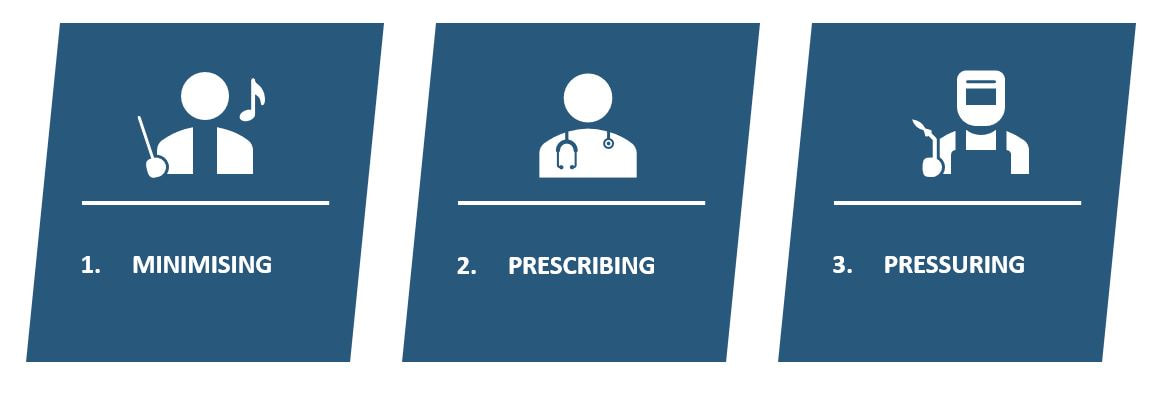
As a seller today I encourage you to avoid these three deadly sins and instead demonstrate true empathy, listen to the customer and be authentic. Only the customer can solve their own emotional state. Your role is to act like a coach with an empathic led conversation. Invite the customer to come up with ideas to help each other through this time and bridge the gap between emotional and rational thinking. Good Luck and if you want to learn more about empathic led conversations click here
 Every article you read on the latest trends in sales tells us selling is getting much harder. We have heard it all before. Buyers are more informed, there is an increased number of decision makers on the buying process and an increased number of sellers involved in the sales process. Other research points to sellers now providing too much information to the buyers to differentiate themselves from the competition. So yes, we all agree it is getting harder to sell, but do we ever to stop to think..."how could we make things easier for our sales people?" "How could we help them to actually provide greater value to our customers by actually giving them time back to spend with them"?
Let me ask you another set of questions. How often do you hear these comments from your sales team? 1. I spent hours last night searching our content management system for that white paper on ROI? 2. The CRM takes me hours to update each day. Can we please have a sales admin resource to support us? 3. Our pricing calculator is useless. It takes me hours to put a quotation together. 4. I'm in yet another internal meeting...I have no time sell? 5. I've got training again this week! 6. It takes so long to get a contract from legal. Do these sound familiar? Do you hear these from the majority of your team. These are all bottlenecks in your sales process preventing your team from being more successful. They make up the tedium of selling. These tasks prevent us being efficient and spending more time with our customers delivering value. The sad thing is many of these mundane tasks can be improved with the aid of simple digital technology. Yes, there are several advanced Learning Management Systems, Content Management Systems and the latest Enablement platforms but how many of them are a square peg in a round hole? We will certainly be exploring some of these systems in future blogs but for this first post I really want to keep things simple stupid. KISS. Let's KISS tedium goodbye by taking some time to review the tedium tasks your sales people face today. Take these 5 steps. 1. Take our Tedium Calculator test 2. Rank the tasks in terms of time eating into their daily routine. 3. Calculate the potential cost in time for completing that routine task. 4. Multiply that time by the number of sales people you have. 5. Now you have a business case. Review the process and do something about it! KISS |

Martin SparkesConsultanting expert on Sales and Service tranformation through Leader led interventions, learning and Digital Enablement. 
ArchivesCategories |
 RSS Feed